
Etiquetado: 2020 Lotus Elise, 202X Lotus Elise, España: Adiós a los Volvo S40 y V50, Geely, geely noticias, Geely se deja de rodeos y anuncia su interés en Volvo, Geely se hace con el control de Lotus, km77, levc, Lotus, Lotus anuncia el motor 1.2 "Range Extender", lotus noticias, Lynk and co, lynk y co noticias, Noticias, noticias de la marca lynk co, noticias de levc, noticias de zeekr, noticias del grupo geely, NOTICIAS Geely Group, Noticias LOTUS, Noticias VOLVO, Polestar, polestar noticias, Volvo, Volvo anticipa eventuales problemas en algunos de sus diésel, Volvo apuesta por el KERS, Volvo pone a prueba su nuevo sistema anticolisiones y fracasa, Volvo trabaja en una carroceria que sirva de bateria, Volvo vuelve a pifiarla en una demostración de sus sistemas de seguridad, Volvo XC40 T2, Volvo XC40 T2 | Prueba
- Este debate tiene 355 respuestas, 56 mensajes y ha sido actualizado por última vez el hace 5 días, 17 horas por
DTM995.
-
Estos días por tierras cántabras estoy viendo bastantes V40 D2 y D3. Para mi lo más bonito del segmento, me alegro por Volvo. [size size=150]Presenta nuevas mecanicas Drive-E y alguna cosa más[/size] 
http://www.autowereld.com/imagesDB/800/3816101456128_.jpg

http://www.autowereld.com/imagesDB/800/3816101459187_.jpg

http://www.autowereld.com/imagesDB/800/381610151128_.jpg

http://www.autowereld.com/imagesDB/800/381610153183_.jpg

http://www.autowereld.com/imagesDB/800/38161015573_.jpg

http://www.autowereld.com/imagesDB/800/3816101527142_.jpg

http://www.autowereld.com/imagesDB/800/3816101529186_.jpg nota de prensa, en inglés
Volvo Cars’ new Drive-E powertrains – efficient driving pleasure with world-first technologiesVolvo Cars’ new Drive-E range of powertrains takes efficient driving pleasure to a new dimension in which the number of cylinders is no longer important to describe power and drivability. The first three engines from the two-litre, four-cylinder Drive-E powertrain family will be launched in autumn 2013. The diesel version features world-first i-Art technology, and the most powerful petrol version comes with a class-leading combination of a compressor and a turbocharger.
«We have created smaller, more intelligent engines with power curves that give exciting driveability compared with engines with more cylinders yet deliver the fuel economy of only four cylinders. In addition, by adding electrification such as plug-in hybrid technology, we will reach power figures in the V8 territory,» says Derek Crabb, Vice President Powertrain Engineering at Volvo Car Group.
The whole Drive-E engine range, which, during the development phase, was called Volvo Engine Architecture (VEA), basically consists of two four-cylinder engines, one common rail diesel and one direct-injected petrol version. They replace eight engine architectures on three platforms.
Drive-E diesels will range from 120 to 230 hp. Petrol versions will start at 140 hp and go all the way up to 300-plus hp.
Several levels of turbo charging open up the flexibility to cover the whole range, from fuel-efficient derivatives through to high power and torque variants. In order to cover all customer requirements, some engines will also gain added performance via electrification or other spearhead technology.
Three Drive-E engines
Initially, the new S60, V60 and XC60 will be available with three engines from the new engine family: the 306 hp petrol turbo T6, the 245 hp T5 and the turbo diesel D4 with 181 hp. A new 8-speed automatic gearbox contributes to a refined drive and excellent fuel economy. The T5 and the D4 are also available in the new Volvo V70, XC70 and S80.Volvo Cars’ power train experts have developed the engines in-house. They are being built at Volvo Car Group’s high-tech engine plant in Skövde, Sweden.
New eight-speed automatic gearbox
To deliver the desired responsive, smooth and fuel-efficient drivability, the engines are teamed either with a new eight-speed automatic gearbox or an enhanced six-speed manual, tuned for improved fuel economy.«The sophisticated Drive-E technologies give the customer high performance, improved fuel economy, considerably lower emissions and a powerful sound character. Our four-cylinder engines will offer higher performance than today’s six-cylinder units and lower fuel consumption than the current four-cylinder generation,» says Derek Crabb. He adds: «If you take a four-cylinder Drive-E engine versus any six-cylinder engine, there’s a massive weight and size reduction for the same power. Fuel economy savings are anything from 10 to 30 per cent, depending on which engine you’re comparing it to.»
Diesels with world-first i-Art technology
The diesels feature world-first i-Art technology. By featuring pressure feedback from each fuel injector instead of using a traditional single pressure sensor in the common rail, i-Art makes it possible to continuously monitor and adapt fuel injection per combustion in each of the four cylinders.«Increasing the rail pressure to an exceptionally high 2,500 bar, while adding the i-Art technology, can be described as the second step in the diesel revolution. It is a breakthrough comparable to our invention of the lambda sensor for the catalytic converter in 1976. It’s another world first in passenger cars for Volvo,» says Derek Crabb.
Each injector has a small computer on top of it that monitors injection pressure. Using this information, the self-adapting i-Art system makes sure that the ideal amount of fuel is injected during each combustion cycle.
The combination of higher injection pressure and i-Art technology gives the customer an engine with improved fuel economy, considerably lower emissions and high performance output as well as a powerful sound character.
The diesels also feature refinements such as state-of-the-art twin-turbo, reduced friction and a smart valve solution on the cooling system for a more rapid heat-up phase after a cold start.
Petrol engine with compressor and turbo
Using the supercharger to fill in the bottom end torque gives the petrol engine a big, naturally aspirated feel. The mechanically linked compressor starts to function immediately at low revs, while the turbocharger kicks in when the airflow builds up.Other improvements to the Drive-E petrol engines include friction-reduction measures such as ball bearings on the camshaft, high-speed continuous variable valve timing and intelligent heat management with a fully variable electric water pump.
Prepared for electrification
The Drive-E engines are prepared for future electrification from the start. Key components, such as the Integrated Starter Generator, can be connected easily – and the compact size of the four-cylinder engines means that the electric motor can be fitted in the front or rear of the vehicle. The battery pack will be located in the centre of the car.Downsizing without compromises
Volvo Car Group is highly confident that the focus on four-cylinder Drive-E powertrains is the right way to create the desirable blend of power, drivability and fuel efficiency.«The power you get from an engine has nothing to do with its size; it is about the amount of air that you can get to flow through it. You can also make an engine more efficient if you make it smaller. So, if you can get more air through a smaller engine, you can still get the same power but at better efficiency,» says Derek Crabb, concluding: «When I was involved in Formula One engines, they were producing 1.5-litre turbo charged engines capable of over 900 hp. And these new Volvo Drive-E engines have in fact been tested on the racetrack already. The engine we used in Volvo’s WTCC car in 2011 was a Drive-E prototype and by the last race we set a new track record.»
Cada vez me gusta más VOLVO. Otra marca de las marcas «muy pequeñas» con un «buen rumbo» definido.
Si no he leído mal: motores diesel 2.0 litros 4 cilindros con hasta 230 cv.
Nuevo familia de motores, nueva plataforma modular, nuevos sistemas de seguridad avanzados (sobre todo para evitar animales) y un gran futuro.
Según dijeron hace tiempo, se centrarían en bloques de 4 cilindros.
A ver si adelantan el S80 por que está un poco desfasado. El XC90 va para el año que viene.
Es la marca con mas personalidad y, para mi gusto, la que hace mejores coches. Es la marca Premium de la que algún día me gustaría tener un coche.
Estrategia de motores futuros para Volvo. No hay ni 6 ni 8 cilindros.
Las versiones más altas serán 4 cilindros + hibridación.
La berlina alta se llamará S90
Bueno, queda una zona sin especificar, en la parte altísima de los S90 y XC90

http://nsae01.casimages.net/img/2013/09/02/130902042323598068.jpg Interesante.. s60’s con 3 cilindros.
Lástima que no extiendan la electrificación para motores pequeños. Por ello dan a entender que la electrificación sólo la utilizarán para «simular» motores grandes pero no para hacer motores de poco consumo para gamas bajas.
AUTOCAR prueba dos de los NUEVOS MOTORES DE VOLVO 4 CILINDROS: 2.0 TURBO 306 CV
2.0 D 180 CVhttp://www.autocar.co.uk/car-review/volvo/v60/first-drives/2014-volvo-v60-d4-first-drive-review [size size=150]Geely confirma una berlina de lujo para Volvo[/size] Li Shufu, presidente de Geely y Volvo, ha confirmado que Volvo tendrá un rival para los A8, serie 7, clase S y compañia.
Montaria la plataforma SPA de nueva concepción, estando alargada con respecto al proximo sustituto del S80, el S90http://www.leftlanenews.com/geely-chairman-confirms-rangetopping-volvo-sedan.html [size size=150]Geely confirma una berlina de lujo para Volvo[/size] Li Shufu, presidente de Geely y Volve, ha confirmado que Volvo tendrá un rival para los A8, serie 7, clase S y compañia.
Montaria la plataforma SPA de nueva concepción, estando alargada con respecto al proximo sustituto del S80, el S90http://www.leftlanenews.com/geely-chairman-confirms-rangetopping-volvo-sedan.html Curiosa noticia.
Hace semanas en Autonews leí un artículo donde explicaba los roces del CEO de Volvo y del dueño de Geely.
El chino quería una berlina de lujo del tamaño A8. Clase S, Serie 7. El CEO de Volvo decía que ese no era su terreno, si no gamas más bajas diferenciándose de la competencia.
El chino se mostraba enfadado ya que pensaba que en China una berlina de super lujo de Volvo se vendería muy bien.
[size size=150]Volvo execs, owner Geely clash over brand direction[/size] September 10, 2013 – 3:40 pm ET
Safe, solid and understated in a Swedish way, or an aspiring luxury brand eager to pander to a Chinese taste for excess and ‘bling’: that’s the debate causing ripples at the top of Volvo Car Corp., which has been under Chinese ownership since 2010.
A culture clash between Volvo’s European management and Zhejiang Geely Holding Group Co., the brand’s owner, may have broader implications for corporate China. If Geely prevails in refocusing Volvo on China’s premium market, it could chart a course for other Chinese firms with global ambitions.
The Volvo Concept Coupe, unveiled on Tuesday at the Frankfurt auto show, is a sign that Chinese ownership wants to shed Volvo’s sober image and grow sales significantly by taking on established luxury brands such as BMW, Daimler’s Mercedes-Benz and Audi.
According to four people close to Volvo and Geely, the Chinese firm’s billionaire owner Li Shufu believes China, where more than 1.2 million premium cars were sold last year, is key to Volvo’s future, and will help it hit a target of doubling annual global sales to 800,000 vehicles by 2020.
Volvo’s year-on-year sales in China grew by two-thirds in August to 4,319 cars. January-August sales were up 40 percent to 37,661 cars.
To get to its target, Li, who is chairman of both Geely and Volvo, wants the Swedish carmaker to come up with a large premium sedan aimed at China’s newly wealthy who tout their social status with German luxury cars, such as the Audi A8 and BMW 7-Series sedans.
Managers at Volvo are not on the same page. Hakan Samuelsson, CEO since late last year, believes it’s too big a risk for Volvo to give up a niche cultivated over decades with a focus on safety and Scandinavian understatement and try to take on German luxury carmakers.
«Volvo will never compete in that segment where customers are expecting to have V12 or V8 engines. Volvos are 4-cylinder and 6-cylinder engine cars,» he told reporters in June at a plant opening in the southwestern China city of Chengdu. «Showing off has never been part of the Volvo brand.»
A bit of a stretch?
Volvo’s management also believes it makes little economic sense to come up with a rival to the BMW 7-Series or Mercedes S-class because the large, rear-wheel drive sedans are costly to develop and Volvo lacks the scale to make a quick return on the investment.Volvo’s compromise to Li is to meet halfway by creating a stretched and more luxurious «China version» of the smaller S80 sedan, currently being redesigned, the insiders said.
«We told Chairman Li we should stay away (from a luxury flagship sedan). It’s too long a journey to make with little hope for a quick return,» said one senior Volvo executive, who asked not to be named as the discussions were private. «We think it’s better to spend your money in areas where we can make a difference. We told him that, and I have the feeling he buys into that.»
Indeed, Li said at the Chengdu event that he is ready to support Volvo’s traditional niche even as it tries to restyle its lineup, including the Concept Coupe, which is a modern take on the Volvo P1800 from the 1960s.
«Future cars I’ve seen, which designers presented to me, are really appealing,» Li said. «I feel very happy and confident this will be a great success.»
While Li publicly touts the progress the two companies have made in upgrading Volvo’s technology — especially new «scalable» architecture underpinning a range of larger Volvo cars — two people close to Li say he is still trying to nudge Samuelsson to compete with the Audi A8, with a plusher and bigger model he calls the S100.
Sales of high-end cars, particularly in the super-luxury category such as Bentley and Lamborghini, are likely to slow as China’s economic growth eases and new political leadership takes aim at lavish spending and graft. But Li still sees growth potential in China’s luxury car market, which is expected to overtake the United States as the world’s biggest by 2020, with annual sales of around 3 million cars.
Vulgar Volvo?
Li’s comments at Chengdu indicate a narrowing of the difference in thinking over how far to go in giving Volvo an up-market make over. Insiders say Li is a big fan of the new styling that design chief Thomas Ingenlath has brought to Volvo.
Samuelsson and his product strategy chief Lex Kerssemakers insist Volvo should stick to its Scandinavian roots, in part because Chinese consumers are changing and no longer seek to flaunt their status through owning a German luxury car. «That shift started in many countries years ago, but you also see it now in China,» Kerssemakers said in Chengdu.
Li, though, still believes Volvo needs a flagship head-turner sedan for China, say those familiar with his thinking.
«Show-off people» are the main customer base for luxury cars in the world’s biggest autos market, they say. During a weekly conference call with Samuelsson around Chinese New Year, Li again pushed Volvo to develop a large flagship sedan, they said.
He failed, and was «not too happy» after that call, one insider said, as «Hakan (Samuelsson) was not as straightforward as (his CEO predecessor) Stefan Jacoby.» While Li wields the power, he «plans to deal with this issue diplomatically,» the person said.
«Volvo management says they (ostentatious Chinese consumers)are not our target customers. The problem is, there aren’t many people in China today with good taste,» said one of those close to Li. «Mistresses love BMWs. Coal mine owners and property developers drive Mercedes. Those rich people like to show off.»
Li is expected to attend the Frankfurt show and then head to Gothenburg for a presentation by Volvo management on the brand’s future cars. Volvo managers remain confident Li will support the compromise of a stretched S80 to appeal to Chinese drivers.
Michael Xu, a Volvo dealer in Chengdu, said there is a gap in target customer awareness for the Volvo brand versus BMW, Audi and Mercedes, and he would welcome Volvo adding a «very high level» model, priced at 1 million yuan ($163,400).
«That type of model would help build Volvo’s brand image … and boost awareness for the brand,» said Xu.
Si, de hecho en el blog tambien ponen eso, que al principio decian que no, pero han cambiado de idea Si lo sacan, que lo llamen S90, pero que no llamen así al sustituto del S80, por qué que el otro se llamase S100, chirría en demasía. Para mi es un error competir en la categoría del A8, S7. En China venderían algo, pero en el resto del mundo nada. Y hacer un modelo sólo para China es arriesgado para Volvo.
El S90 (sustituto del S80) podría aumentar de tamaño y quedarse en 5,00 metros y estaría entre los Segmento E y F.
Parece ser que lo que parecia que era una noticia no lo es.
Per-Ake Froberg, vicepresidente de relaciones publicas, acaba de decir que lo que dijo Li Shufu no es correcto, no habrá berlina mas grande que el proximo S90http://www.caradvice.com.au/253107/volvo-refutes-s100-luxury-flagship-suggestions/ [size size=150]Volvo ayudará a Geely a crear un coche de segmento B para todo el planeta[/size] Tranquilo, Volvo no se va a meter, por el momento al menos, en el segmento B. Pero de la asociación entre los suecos y los chinos en cuanto a I+D en el centro de desarrollo instalado en Suecia el año pasado va a nacer un coche de segmento B para Geely, que buscará comercializarse tanto en Europa como en América.
La colaboración en el desarrollo de esta plataforma buscará crear un producto que, por calidad y seguridad, esté a la altura de lo que los occidentales esperan de un coche. Con esto, Geely debería poder convertirse en una de las primeras firmas chinas, tras Qoros, en lograr destacar en seguridad en un mercado donde lo chino todavía se mira con desconfianza.
La gran cuestión ahora es dónde pretende vender Geely este nuevo producto. Y es que no cuenta con red comercial en occidente. ¿Tirará de la red consolidada de Volvo? Parece poco probable, pues la exposiciones de una marca premium no son el mejor lugar para vender una alternativa al Ford Fiesta y compañía. Pero crear una red desde la nada también se antoja complejo.
Sea como sea, con I+D de la mano de Volvo y componentes suministrados por el gigante Brose (sí, la compañía del propietario del New Stratos), el nuevo utilitario promete estar a la altura.
Via
http://es.autoblog.com/2014/01/28/volvo-ayudara-a-geely-a-crear-un-coche-de-segmento-b-para-todo-e/ [size size=150]Está desarrollando nuevos sensores de control de atención del conductor[/size] VOLVO CARS CONDUCTS RESEARCH INTO DRIVER SENSORS IN ORDER TO CREATE CARS THAT GET TO KNOW THEIR DRIVERSThrough systems that can recognise and distinguish whether a driver is tired or inattentive, the car of the future can become even safer. Examples of this include technology that detect closed eyes or what the driver is looking at.
“This will enable the driver to be able to rely a bit more on their car, and know that it will help them when needed,” explains Per Landfors, engineer at Volvo Cars and project leader for driver support functions.
By placing a sensor on the dashboard to monitor aspects such as in which direction the driver is looking, how open their eyes are, as well as their head position and angle, it is possible to develop precise safety systems that detect the driver’s state and are able to adjust the car accordingly. This also means that the car will ensure that it does not stray out of the lane or get too close to the car in front when the driver is not paying attention, as well as being able to wake a driver who is falling asleep.
“Since the car is able to detect if a driver is not paying attention, safety systems can be adapted more effectively. For example, the car’s support systems can be activated later on if the driver is focused, and earlier if the driver’s attention is directed elsewhere,” Per Landfors explains.
Some of the current systems that can be included are Lane Keeping Aid, Collision warning with full auto brake and Adaptive Cruise Control with Queue Assist.
The technology is based on a sensor mounted on the dashboard in front of the driver. Small LEDs illuminate the driver with infrared light, which is then monitored by the sensor. Infrared light is just outside the wavelengths that the human eye can see, which means that the person behind the wheel doesn’t notice it at all.
Driver sensors are also opening up other possibilities. By monitoring eye movements, the car would be able to adjust both interior and exterior lighting to follow the direction in which the driver is looking. The car would also be able to adjust seat settings, for instance, simply by recognising the person sitting behind the wheel.
“This could be done by the sensor measuring between different points on the face to identify the driver, for example. At the same time, however, it is essential to remember than the car doesn’t save any pictures and nor does it have a driver surveillance function,” Per Landfors clarifies.
The technology is already installed in test vehicles. Volvo Cars is also conducting research together with partners including Chalmers University of Technology and Volvo AB to identify effective methods for detecting tiredness and inattention.
The analysis of the driver’s state, known as Driver State Estimation, in which driver sensors play an important role, is a field that may be key to self-driving cars in the future. The car will need to be able to determine for itself whether the driver is capable of taking control when the conditions for driving autonomously are no longer present. A driver sensor could be of assistance in this.
This technology is one of the many initiatives bringing Volvo Cars closer to its goal for 2020 – that no one shall be killed or seriously injured in a new Volvo.
http://www.worldcarfans.com/114031771913/volvo-testing-smart-sensors-that-can-determine-if-youre [size size=150]En desarrollo un nuevo sistema de comuunicación para predicción del tiempo meteorológico[/size]
Nota de prensa, en inglés
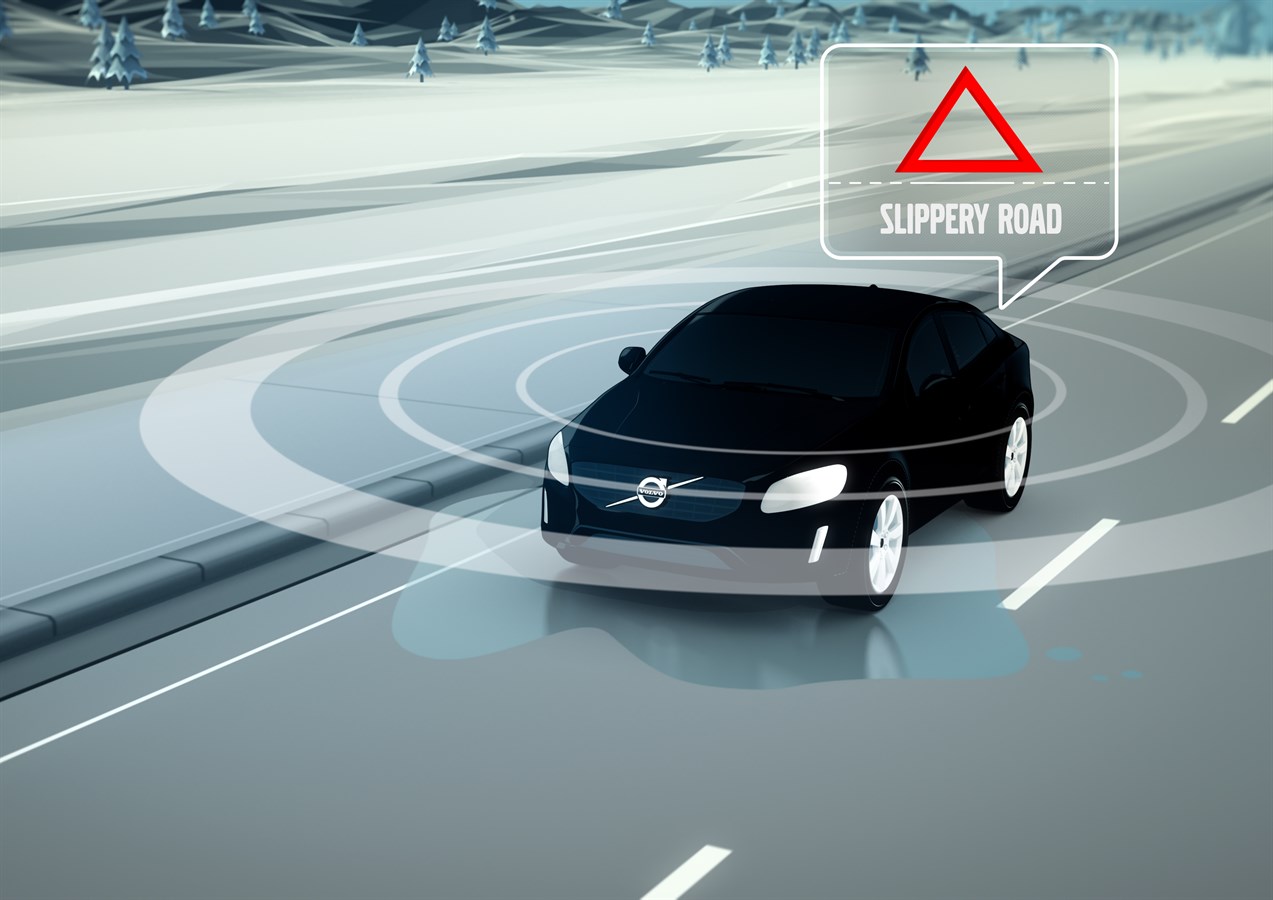
Volvo Car Group initiates Scandinavian pilot using cloud-based communication to make driving saferhttps://www.media.volvocars.com/image/low/136804/1/5 Volvo Car Group (Volvo Cars), the Swedish Transport Administration (Trafikverket) and the Norwegian Public Roads Administration (Statens Vegvesen) are joining forces in a pilot project in which road friction information from individual cars is shared within a cloud-based system.
The real-time data about slippery patches on the road are used to warn vehicles nearby, at the same time as it contributes to making winter road maintenance more efficient.
“The pilot is one of the first practical examples of the way communication between vehicles over the mobile network enables vehicles to ‘speak’ to each other and with the traffic environment. This can contribute to making traffic safer,” says Erik Israelsson, Project Leader Cooperative ITS (Intelligent Transport System) at Volvo Cars.
“We have 50 test cars on the roads, and next winter the fleet will grow considerably. Our aim is to make the technology available for our customers within a few years,” he adds.
https://www.media.volvocars.com/image/low/141064/1/5 Using the mobile network
When the Volvo test car detects an icy or slippery road patch, the information is transmitted to Volvo Cars’ database via the mobile phone network. An instant warning is transmitted to other vehicles that are approaching the slippery area, making it possible for the drivers to take immediate action to avoid a critical situation.A slippery road warning on the instrument cluster alerts the driver. The application in the vehicle will be designed to adapt the driver warning to match the severity level based on the vehicle speed and the present road conditions.
Improved winter road maintenance
The information about the icy patch is also sent to the road administrator as a complement to existing measurement stations along the road. The data can help the road administrator and their contracted entrepreneurs to better plan and execute winter road maintenance and quickly address changed conditions.“When the road administrator has access to information from a large number of cars, the data can be used to make winter road maintenance more efficient. The information could help to improve road safety further for all road users. This could also reduce the use of salt when not needed and minimise the environmental impact,” says Erik Israelsson.
Volvo Cars recognizes that the maintained integrity of end-users is an important aspect of the system. The information shared with the road administrator will not include data of unique vehicles. The aggregated information is used solely to describe the present status of the road network.
Ambitious connectivity strategy
Volvo Cars strategically invests in and initiates partnerships to create cloud-based solutions, and the slippery road warning is the first safety feature in the Volvo cloud. The development of sophisticated communication via the mobile network is part of the company’s aim to offer customers a fully connected experience.“This is only the beginning. In the future we will have increased exchange of vital information between vehicles,” says Erik Israelsson. “There is considerable potential in this area, including safer traffic, a more comfortable drive and an improved traffic flow.”
“The strategic focus on connectivity within our new Scalable Product Architecture paves the way for more cloud-based safety solutions. This will bring us closer to our safety vision that nobody should die or suffer serious injuries in a new Volvo car by the year 2020,” concludes Erik Israelsson.
Volvo podría estar considerando producir el Concept Estate presentado en Ginebra 14 [size size=150]Nuevo motor conceptual Drive-E de 450cv[/size]
– Se saca de un 2.0 Triturbo
– Son 2 turbos en paralelo que son alimentados por otro, pero en este caso, electrico
– Inyección a 250 bares de presión[youtube]c3CFpFC5y18[/youtube] 
http://content.worldcarfans.co/2014/10/7/super/11153521021464911774.jpg

http://content.worldcarfans.co/2014/10/7/super/8096662172010196496.jpg

http://content.worldcarfans.co/2014/10/7/super/4932560302116819251.jpg

http://content.worldcarfans.co/2014/10/7/super/14469867161202475650.jpg

http://content.worldcarfans.co/2014/10/7/super/18976093641613441258.jpg

http://content.worldcarfans.co/2014/10/7/super/262142453436676379.jpg

http://content.worldcarfans.co/2014/10/7/super/717238207411289621.jpg

http://content.worldcarfans.co/2014/10/7/super/8153153641628845464.jpg Nota de prensa en inglés
Volvo Cars reveals 450hp High Performance Drive-E Powertrain Concept– Triple Boost Technology takes Volvo’s four-cylinder Drive-E Powertrain petrol engine to 450hp
– Further proof of Volvo’s commitment to delivering driving pleasure through down-sizingVolvo delivers a unique combination of performance and efficiency with the High Performance Drive-E Powertrain Concept – a triple boost 2.0-litre 4-cylinder petrol engine with no less than 450hp.
Following the successful introduction of Volvo’s Drive-E Powertrain range in 2013, Volvo’s powertrain team once again demonstrates its technological leadership in emission-reducing turbo technology.
«When we launched the Drive-E powertrain family, our aim was to deliver the most advanced 4-cylinder engines in the industry based on emissions and fuel consumption relative to performance and drivability,» says Dr. Peter Mertens, Senior Vice President for Research and Development at Volvo Car Group.
«We knew that 320hp in our petrol configuration was just a starting point. The 450hp High Performance Drive-E Powertrain Concept, demonstrates this ambition and the versatility of the Drive-E Powertrains.»
The 450hp High Performance Drive-E Powertrain Concept is based on a set of technologies not usually found in a four-cylinder engine.
The engine utilises two parallel turbochargers, which are fed by an electrically powered turbo-compressor. The compressed air from this unit, rather than being fed to the cylinders, is instead used to spool up the two parallel turbochargers. Fuel is fed by a dual fuel pump working at 250 bar pressure. With this kind of power density, this triple boost installation and unique fuel system, enables a very dynamic drivability without any turbo lag, compared to a mono-turbo.
«There are several high power small size applications where one large turbo is used to create a high level of power available from other manufacturers, but the driving experience suffers due to slow engine response. We felt that with our heritage of being among the first car companies to embrace and offer a broad range of turbo technology since 1981, that we could improve this,» says Michael Fleiss, Vice President of Powertrain Engineering at Volvo Car Group.
The High Performance Drive-E Powertrain Concept attracted the attention and involvement of Volvo Cars suppliers AVL, Denso and Volvo Polestar Racing at an early stage, which allowed theories and technologies from racing applications to be infused in the development process.
«This was a very exciting project as we pioneered a combination of technologies in the same application, and the result is a quite unique engine with its high power yet quick response. Above all, its compact size improves weight distribution between the front and rear axle and lowers the center of gravity – two factors that have a significant effect on the handling, whether it is a race car or a street car,» said Mattias Evensson, Race Engine Director at Volvo Polestar Racing.
«It may sound odd, but this 450hp engine is part of this work. Down-sizing must offer customers attractive and usable power for broad scale emissions reduction to work. Compact powertrains free up space and weight in the structure of the car, which can be used for electrification and even further emissions reduction. And that is our ultimate ambition,» concludes Dr. Mertens.
Fabricará la berlina premium grande en ChinaVolvo Cars expands Daqing operation[i]Daqing to become one of China’s most advanced car plants
Expansion will spur economic development in the Daqing region
Commitment will further boost Volvo’s sales in China[/i] Volvo Cars today underlined its long term commitment to China by significantly expanding its manufacturing facility in Daqing, China. The company will use its Daqing plant to make the most innovative vehicles in its product range, which are based on its Scalable Product Architecture (SPA), a flexible, scalable product architecture that covers most of Volvo’s future car models. This move will make Daqing one of the most advanced car making facilities in China.
Volvo Cars has an existing manufacturing facility in Daqing which was founded in September 2013. Its first product, the XC Classic, is the latest version of Volvo’s world famous XC90 SUV, and was launched in China in September 2014.
The existing Daqing plant has around 700 employees and an initial capacity of 80,000 vehicles. The first SPA Volvo to be made in Daqing will be an all-new premium Sedan.
The Volvo Cars manufacturing plant in Daqing, China
Volvo Cars’ decision to significantly expand production in Daqing highlights its growing commitment in China. The Swedish company is majority owned by Zhejiang Geely Holding, a Chinese company, but also enjoys a close and developing relationship with the Daqing city government, which owns 37 per cent of Volvo Cars.
Volvo Cars and the city of Daqing are working together to help spur economic growth and development in the city and surrounding region, driven by Volvo Cars’ growing presence in the fast growing Chinese car market.
Volvo Cars expects sales in China to surpass 80,000 this calendar year, making China Volvo’s largest global market. It has a long-term goal of selling 200,000 cars a year in the country.
«Daqing will become an integral part of our global industrial footprint,» said Håkan Samuelsson, Volvo Cars’ President and Chief Executive. «We are pleased to announce that we are going to introduce SPA and a new sedan here. We are fully committed to the growth of our business in China, our second home market.»
Cars made in the Daqing plant will be of global standards. The Daqing plant will fully adhere to Volvo’s global Volvo Car Manufacturing System (VCMS), and utilize global technology, global sourcing and provide global quality.
«Using precise, standardized production methods and world-class premium automotive technology, Daqing will provide consumers with safe, healthy, environmentally-friendly and tasteful Volvo cars with a flavour of Scandinavian luxury,» said Mr Samuelsson.
[size size=150]Volvo está trabajando en un nuevo motor de 3 cilindros[/size] Desarrollado a partir de los conocimientos adquiridos con los 4 cilindros Drive-E, promete ser mas potente y economico. Hasta 180cv

http://content.worldcarfans.co/2014/12/11/super/446349527979483257.jpg

http://content.worldcarfans.co/2014/12/11/super/10643391921786916937.jpg

http://content.worldcarfans.co/2014/12/11/super/178293233924228011.jpg

http://content.worldcarfans.co/2014/12/11/super/8587561771860127474.jpg

http://content.worldcarfans.co/2014/12/11/super/386155007783262437.jpg

http://content.worldcarfans.co/2014/12/11/super/6664916902049114013.jpg

http://content.worldcarfans.co/2014/12/11/super/2778546641792787638.jpg

http://content.worldcarfans.co/2014/12/11/super/2103777480425274154.jpg

http://content.worldcarfans.co/2014/12/11/super/14753468360943126.jpg Nota de prensa, en inglés
Volvo Car Group already testing its new three-cylinder engine– New 3-cylinder engine developed by Volvo Cars in Sweden
– Volvo’s next step in its impressive Drive-E powertrain program
– Broad range of performance levels up to around 180 hpVolvo Cars today confirms its production program to develop a lightweight 3-cylinder petrol engine. The engine, wholly developed in Sweden, will join the class-leading 4-cylinder Drive-E engines in displaying Volvo’s engineering prowess and commitment to efficient power.
“We have come a long way in the last few years at Volvo. Investments from our parent company, Zhejiang Geely Holding Group, have enabled us to recapture our position as a leader in the field of powertrain engineering. The development program for the new 3-cylinder engine is very advanced and we have already begun prototype testing of the unit,” says Dr. Peter Mertens, Senior Vice President Research & Development at Volvo Car Group.
Volvo Cars’ new three-cylinder engineVolvo has a long history of developing its own unique 6, 5 and 4-cylinder engines and in-house expertise. The move to include a 3-cylinder in Volvo’s engine program is a natural next step in Volvo’s strategy of downsizing. The application of class-leading technology and analysis techniques enables more power and better fuel economy from smaller displacement internal combustion engines than ever before.
“We have learned a lot from the development of our 4-cylinder Drive-E engines and translated this into a highly responsive, compact and powerful premium-quality 3-cylinder engine. The engine is being developed primarily with our new CMA architecture in mind but will also provide power for our 60 Series cars thanks to Volvo’s advanced turbo technologies, while also meeting Euro 7 emission targets,” says Michael Fleiss, Vice President Powertrain at Volvo Car Group.
Built with a keen eye on the future, the new Drive-E 3-cylinder engine is designed to support several different applications, in-line with the growing demand for a real-world blend of performance and efficiency.
“The beauty of the new 3-cylinder engine we are developing is that it can be built on the same production lines as our 4-cylinder engine, offering flexible production potential which can be adapted to suit business needs as we grow. This marks an important step forward for Volvo Cars. In terms of our power and efficiency, Volvo’s engineering excellence will shine through with the Drive-E 3-cylinder engine,” concludes Dr. Mertens.
[i]Notes for editors:
– Volvo’s all-new 4-cylinder Drive-E Powertrains were launched to great acclaim in 2013 offering world class fuel consumption and performance
– The 4-cylinder Drive-E engines are used as the base of the new Volvo Twin Engine plug-in hybrid powertrain
– Volvo has been developing its own powertrain solutions since the company was founded in 1927
– The first Volvo engines were cast-iron block side valve engines
– Volvo has built a wide range of 4, 5, and 6 cylinder variant engines over the years
– The Drive-E 3-cylinder engine is yet another step towards zero emissions and real-world performance from Volvo[/i] [size size=150]Volvo compra Polestar[/size] Su intención es hacer de la marca Polestar algo estilo AMG
Nota de prensa, en inglés
Volvo Cars buys 100 per cent of PolestarVolvo Cars, the premium car maker, has acquired 100 per cent of Polestar, the Swedish high performance car company, including the Polestar brand. Polestar will now be used as the model name for special high performance Volvos.
Polestar will also in future utilise Volvo’s twin engine electrification technology to develop next generation performance cars.
Volvo is the largest manufacturer of plug in hybrid cars in Europe and leader in advanced vehicle electrification technology. Volvo currently develops and manufactures some of the most powerful, most environmentally-friendly hybrid engines in the automotive industry.
olvo and Polestar share a long history. They have been working in motor sport since 1996 and in recent years signed a cooperation agreement to jointly develop Polestar versions of Volvo cars that combine a comfortable Volvo driving experience with a very high level of power and handling.
“Driving a Volvo Polestar is a special experience. We have decided to bring this experience to more Volvo drivers, placing the full resources of Volvo behind the development of Polestar as the model name for our high performance cars,” said Håkan Samuelsson, president and chief executive of Volvo Cars.
In 2015, Volvo expects to sell 750 Polestar versions of the V60 wagon and S60 sedan globally. Polestar sales are forecast to increase to between 1,000 and 1,500 cars a year in the medium term under Volvo’s ownership.
The Polestar brand is already firmly established internationally through the sale of Polestar-branded Volvos. Volvo will also benefit from the sale of aftermarket Polestar performance optimisation kits for existing Volvos.
No financial details of the deal have been disclosed. Existing Polestar Performance employees will become Volvo employees.
The Polestar racing team will remain under the control of Christian Dahl, the former owner of Polestar, and will be renamed. The Polestar brand will continue to work alongside Christian Dahl.
“We are extremely satisfied with the way the performance business with Volvo has developed. But we are a racing team first and foremost. This is an opportunity to return our full attention to our core business – to develop and race Volvo cars,” said Christian Dahl.
[i]Notes to editors:[/i]
Volvo has acquired Polestar Performance AB, which comprises performance activities including performance-related software and aftermarket tuning hardware, as well as Polestar Holding AB, which is the owner of the Polestar trademarks. It has not acquired the racing division of Polestar.The Volvo S60 and V60 Polestar feature a 350 horse power T6 engine, making the 0-100 km/h sprint in just 4.9 seconds, and an extensively developed chassis. The car demonstrates Volvo’s and Polestar’s engineering philosophy of delivering an engaging, precise and confident driving experience.
Polestar Performance Optimisations offer increased mid-range engine performance in combination with supporting changes for the gearbox and throttle response to make the car more dynamic and responsive to drive.
Volvo está de enhorabuena con el lanzamiento de XC90 y es todo un placer poder empezar un post así después de los años complicados por los que ha pasado el sector. Parece que la recuperación está cada vez más consolidada aunque este ejemplo no es precisamente el mejor. Como dicen por ahí, «la crisis nos ha afectado a todos, pero más fuerte a los que tenían poca pasta».
El Volvo XC90 no es precisamente un coche para los obreritos de a pie, este SUV del segmento premium roza los 54.000 euros de precio en su versión de acceso y llega a superar los 83.000 euros. Los SUV grandes de lujo siguen siendo un segmento deseado y el gran ritmo de pedidos del nuevo XC90 confirma que hay vida más allá de los modelos alemanes.Por lo que se desprende de la toma de contacto que hizo Josep el XC90 no defrauda en cuanto a producto puro y duro. Pero a veces eso no es suficiente como para que un modelo se venda. El XC90 ha entrado por los ojos y se han disparado los pedidos por encima de las expectativas de la marca sueca. ¿Fueron demasiado conservadores haciendo sus cálculos? Puede ser.
Volvo tenía previsto vender 50.000 unidades en 2015 a nivel mundial y ya hay confirmados 57.000 pedidos. Esto significa que en la planta de Torslanda (Suecia) están trabajando a tres turnos (non-stop) para sacar más XC90 del horno. Además las tres cuartas partes de los pedidos son con el acabado más alto (Inscription), que en España tiene un precio a partir de 66.412 euros.Vía :
http://www.motorpasion.com/volvo/ventas-volvo-xc90-2015 Desvela la estrategia de electrificación global
En 2019 tendrá su primer electrico puro. Tambien quiere tener mas versiones hibridas en la gama, además del XC90 y S90 T8 Twin EngineNota de prensa, en inglés
Volvo Cars unveils global electrification strategyVolvo Cars, the premium car maker, has announced one of the automotive industry’s most comprehensive electrification strategies in which plug-in hybrids will be introduced across its entire range. It will develop an entirely new range of electrified smaller cars and build a fully electric car for sale by 2019.
As part of this new strategy, the Swedish car company said it expects electrified vehicles to account for up to 10 per cent of total car sales in the medium term.
The first element of the new electrification strategy involves the introduction of plug-in hybrid versions of its 90 series and 60 series larger cars, based on the company’s new Scalable Product Architecture. This process has already begun with the launch of the T8 Twin Engine All-Wheel Drive plug-in hybrid version of its new XC90 SUV and will continue with plug-in hybrid versions of the new S90 premium sedan and other forthcoming models.
Volvo Cars will also broaden the range of plug-in hybrid cars it offers with the introduction of a new front-wheel drive Twin Engine variant.
The Swedish car maker will further deepen its product offering with the introduction of an entirely new range of smaller 40 series cars based on its newly-developed Compact Modular Architecture (CMA), which, like SPA, has been designed from the outset for electrification. This makes Volvo Car Group one of very few car makers in the world with two brand new vehicle architectures designed to support both plug-in and pure electric powertrain configurations.
Lastly, Volvo Cars has confirmed that it will build an all-electric car for sale by 2019. Further details of this planned model will be released at a later date.







- Regístrate para acceder al foro, puedes hacerlo siguiendo el botón "Regístrate" en el final de la página.